


Glossary
Here you find a selection of terms which are used to describe watches and also jewellery. Some of these terms usually get used inappropriately and thus can cause misunderstandings. The definitions for these terms you find below, seem the most precise and appropriate to us. We try to apply very strict criteria for their interpretation and explanation. The sources for the info are publicly available. Most info is cross-checked between different sources. We only reference the source when we copy the information without changing it from one single source.
The terms are not listed in a specific order, as we add new ones in irregular intervals.
Please note: This is OUR interpretation/explanation of following terms and how we use them. Sometimes there are no official definitions to be found for them. We can not be held responsible for omissions, misinterpretations or typos.

- Matched: not original to this watch, but period correct
- Diameter, Width (rectangular shaped watches): measurement without the crown
- Lug – lug: measurement taken from external tip of lugs to external tip of lugs
- ‘Vintage’: no defined age, usually older than 20 years
- Antique: older than 100 years
- NOS: New Old Stock, the watch was never used and is untouched but no original box or papers are usually present
- POA: Price on application
- Unpolished case: case with sharp edges, new or as new. Applies for NOS watches or watches which stayed untouched for decades
- Precision criteria:
- Rate: timekeeping error in seconds/day. Positive values: movement is too fast, negative values: movement is too slow
- Beat error: difference (in ms) between the clockwise swing and the counterclockwise swing of the balance.
- Lift angle: angle (degrees) that the balance wheel travels between the first and third noise. Geometric feature of a movement. Angle is stated by the movement’s manufacturer. Usually 52.
- Amplitude: amount of rotation in the swing of the balance wheel, in either direction, usually expressed in degrees. measured dial up.
- BPH: Beats Per Hour, older movements (until late 1940s) have low beats (18’000 BPH, 2.5Hz; 21’600 BPH, 3Hz), movements starting late 1940s have high-beat movements (28’800BPH, 4Hz; 36’000BPH, 5Hz)
- Rolex World’s Records: Precision records. Stamped inside watch case backs of 1920/30s watches.
- No Records: Prior to 1923/24 (1)
- 7 World’s Records: first appearance 1923/24. (1)
- 16 World’s Records: 1927/28
- 20 World’s Records: 1927/28, some overlap with dates of 16 -and 20 world’s records. (1)
- 25 World’s Records: starting 1929.
- 27 World’s Records: starting 1934/35.
- 29 World’s records: between 1934 and 1935, overlap with dates for 27 world’s records
- 31 World’s Records: first published by Rolex in 1935.
- Ref.: (1): vintagewatchstraps
- Yellow gold:
- 9ct gold: 375/1000 purity
- 14ct gold: 575/1000 purity
- 18ct gold: 750/1000 purity
- 22ct gold: 916/1000 purity, crown gold
- 24ct gold: 999/1000 purity, fine gold
- White gold: yellow gold in given purity (9, 14 or 18ct) with addition of other alloy metals to ‘whiten’ its aspect (nickel, silver, palladium) then rhodium plated
- Red, Rose, Pink gold: yellow gold in given purity (9, 14 or 18ct) with addition of copper in different proportions, for 18ct red gold: 25% copper; 18ct rose gold: 22.25% copper and 2.75% silver; 18ct pink gold: 20% copper and 5% silver
- Silver purity:
- 999/1000: fine silver, bullions, too soft for general use950/1000: French standard
- 935/1000: Swiss standard for watch cases after 1887, usually used for export to Britain
- 925/1000 purity: sterling silver, English and American (after 1868) standard
- 900/1000 purity: coin silver, American standard before 1868
- 875/100 purity:
- old Russian standard, marked as 84 (zolotnik)
- old Swiss standard, usually used for export to Russia
- 800/1000 purity: German standard after 1884, old Swiss standard, usually used for export to Germany
- Platinum purity:
- All Plat, Platinum: at least 95% platinum90 Plat 10 Irid: 90% platinum + 10% iridium900pt: 90% platinum
- No platinum mark: < 50% platinum, tests as platinum
- Gold plated (GP): base metal (brass, copper, nickel) covered with a very thin gold layer (of given purity), applied in galvanic bath, gold layer is less than 2.5µm thick:
- < 0.175µm: gold flashed, gold washed
- 0.175µm: gold electroplate
- 0.5µm: gold plate
- 2.5µm: heavy gold plate
- Rolled gold (RG): gold sheets (of given purity) are pressure and heat bonded onto a base metal (brass, copper, nickel), a
- minimum of 2.5% – < 5% gold by weight, < 10µm thick
- Gold filled (GF): gold sheets (of given purity) are pressure and heat bonded onto a base metal (brass, copper, nickel), a minimum of 5% gold by weight, usually 10 – 20µm thick
- Gold capped: thick gold sheets (of given purity, usually 14ct or more) are pressure and heat bonded onto a base metal (usually stainless steel), usually > 40µm thick
- Vermeil: silver coated with gold at least 2.5µm thick
- Diamond historical cuts (relevant selection):

- Rose Cut: used from 15th – mid 19th century, shaped like rose bud, flat bottom (no pavilion), 3 – 24 facets, the older the less facets, extremely rarely found (1:10’000 cut diamonds), stone mostly of Indian origin, hand cut in Europe
- Old Mine Cut (OMC): or Peruzzi cut, diamond origin India or Brazil, 58 facets, first precursor of brilliant cut, different shapes (cushion, pear, marquise, heart, not round), used from 17th – to ca. 1920, smaller table, deeper pavilion, larger culet and higher crown than brilliant cut, entirely hand cut
- Old European Cut (OEC): 58 facets, direct precursor of brilliant cut, round, used from 1900 to the end of 1930ies, smaller table, heavier crown than OMC; smaller table, larger culet, and higher crown, than brilliant cut, entirely hand cut, rarely found in watches
- Brilliant cut: 57 (+1 if culet is cut) facets, American standard published 1919, German standard (Eppler cut) introduced 1939, machine assisted cut, the cut mostly used in vintage and modern watches
- Picture taken and modified: diamond anatomy, credit GIA
- Diamond fancy cuts (relevant selection):

- Picture taken and modified: credit Pinterest
- Trench watch: describes watches worn in the trenches of WWI. Usually silver cased with fixed lugs and enamelled dial with application of luminous compound (radium) also on hands. Term falsely used for all fixed lugged watches.
- Rolex Sub-Brands: Wrongly considered as ‘Rolex’ watches. Brands once belonging to the Rolex S.A. group. Purpose of these sub-brands was to cover all possible markets (geographically and price range wise) for watches. All but ‘Tudor’ have disappeared after ca.1940. None of the watches of these sub-brands attain the quality of Rolex watches and thus can NOT be considered as such. Brand examples: Tudor, Marconi, Rolco, Aqua, Unicorn, Oyster, Genex, Marguerite, (list not exhaustive).
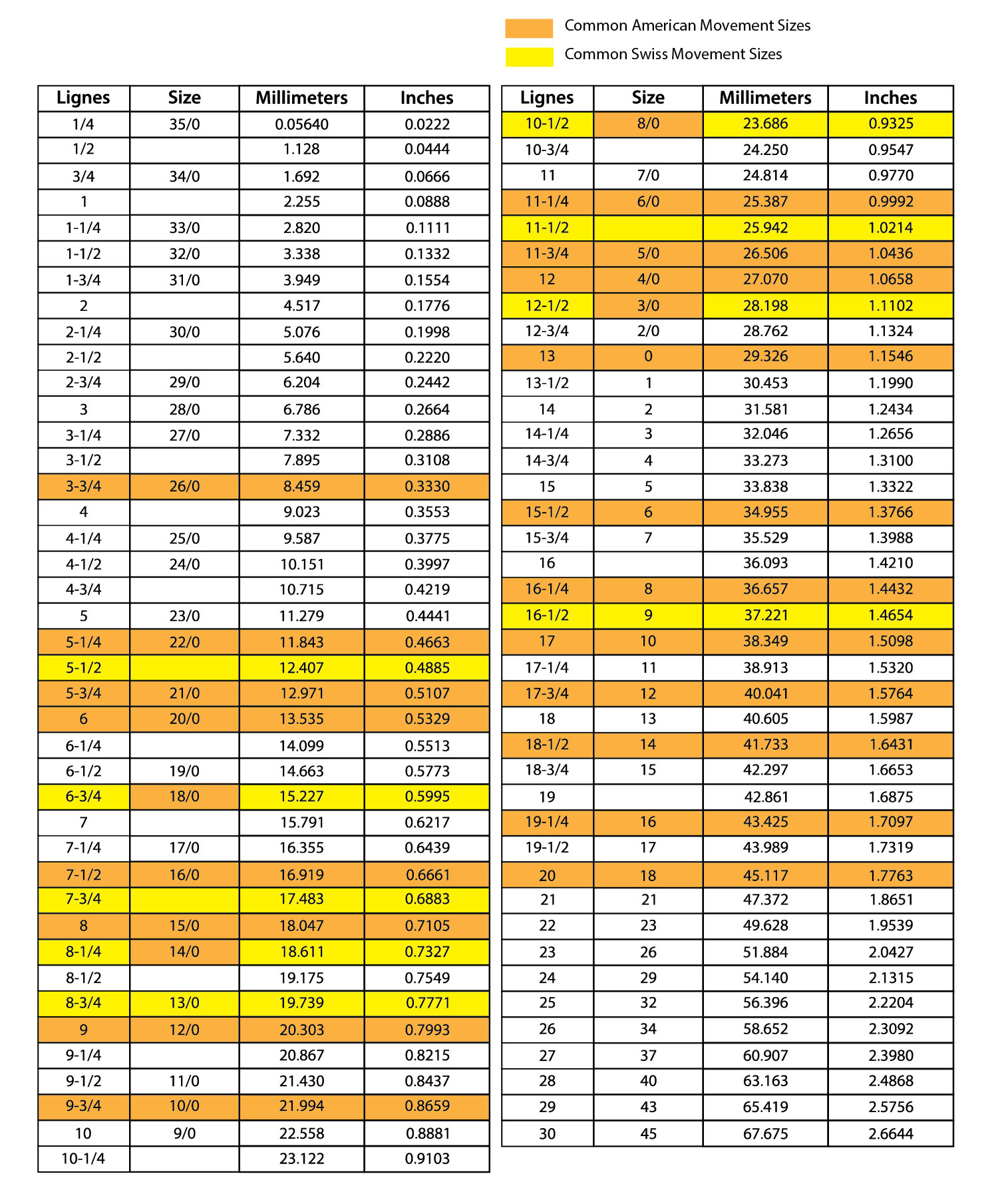
- Ligne, Lignes (plur.): Measurement for watch calibers. 1Ligne = 2.256mm
- Picture taken from: Esslinger
- Tachymeter scale: measuring speed over a given distance.
- Telemeter scale: estimate of distance from an event that is both visible and audible (Ex.: lightning flash followed by audible thunder).
- Pulsometer scale: medical use, total heartbeats per minute. Scale must include how many beats need to be counted, usually 30 or 15 (Ex.: ‘gradué pour 30 pulsations’). Pulsometer scales calibrated for 60 pulsations are usually for veterinary use, when examining medium sized animals such as sheep, dogs, cats or rabbits.
 coronetwatches.com